

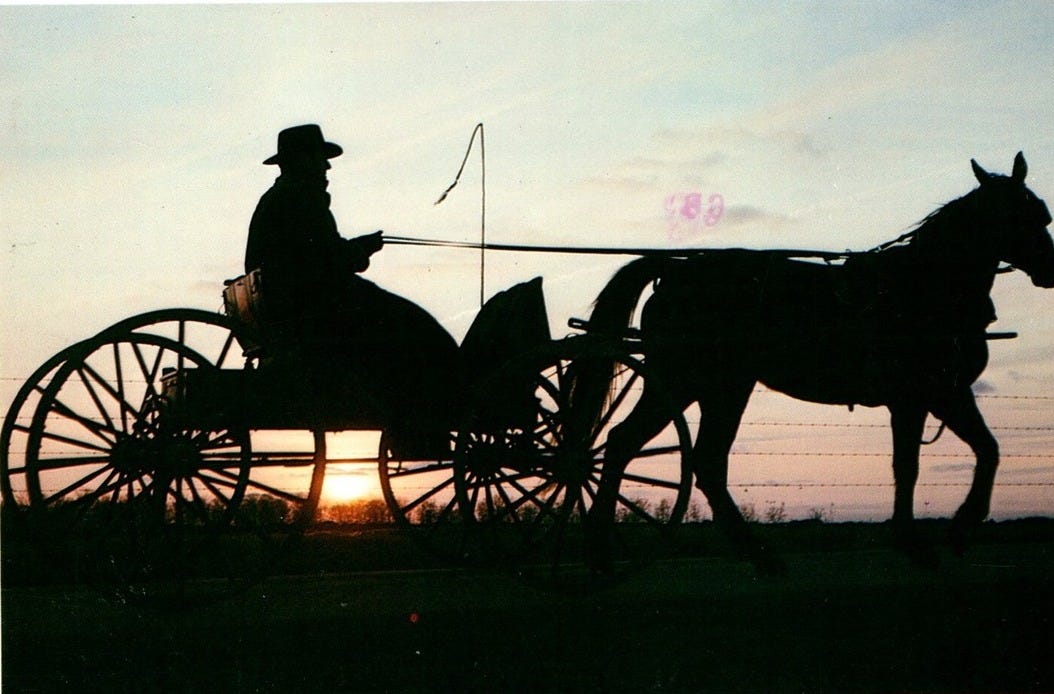
The contrast of Amish life with the modern orthodoxy fascinates many. Religion closely governs them. Their separateness from mainstream society, notably marked by a rejection of technology, the use of horse and buggy over the car, and clothing evocative of centuries past set them apart. Some time ago, I wondered whether a similar community existed in Britain. I found the Bruderhof, founded in 1920, which has two sites in this country, one in Sussex and one in Kent. Like the Amish, they are Anabaptist. Intrigued by the prospect of finding out more about a group whose lives differ so much from the overwhelming majority of those living in the modern West, I decided to pay them a visit.
So pleasant is the peace where only the gentle movement of swaying tree branches can be heard during breaks in conversation with my host. For the purpose of this article, I will call him Jack. We are sitting in a communal area of the Bruderhof site at Beech Grove, Kent, which is roughly one square mile and home to around 250 people. After arriving at a train station, he brought me here by car. This fact and his attire: a Puma hooded jumper, jeans, and Nike trainers are clear signs that the Bruderhof significantly differ from the Amish.
Jack tells me the Bruderhof do not think it necessary to avoid technology as the Amish do. He says there should be a reason for doing things and that persisting with habits without a religious basis is to uphold a way of life for its own sake rather than because it allows one to adhere closely to God. But the Bruderhof approach to technology and access to information is by no means permissive. Brothers and sisters (as Bruderhof members are called) can have smartphones once they turn eighteen. And pupils at their schools use these devices under supervision. Jack tells me that since the coronavirus lockdowns, technology has become more common on site following government dictates regarding reporting infection and following social distancing guidelines. When I ask him about the degree of freedom members have in this area, he tells me responsibility is invested in the individual and that people discuss things in a climate of openness.
The Bruderhof experience of technology and information is constrained by the fact that members have no money. Things are held in common. I turn to the subject of learning and enquire about how the relationship of the group to money is dealt with when, for example, someone wants to buy a book. Jack tells me that this would involve the person requesting the item from those in charge of funds, and then it would usually be bought provided the work is not “wacky”. Who decides what is wacky? Although the caution of the community as per smartphones will meet with the approval of many who understand the capacity for this medium to create a range of distractions and issues, and many at sharp variance with Bruderhof ideals, the gate-keeping of intellectual enquiry will no doubt be opposed by those who feel this is too much of an infringement on individual rights. In fairness, Jack gives me the impression that the interdiction of books is not something that regularly occurs here.
Jack says reasonable requests for money are usually accepted by those given financial responsibility. ‘‘If I ask for £20 or £50 to go to the pub in Canterbury and watch the football, I’ll probably get it,” he tells me. And he summarises the relationship of the Bruderhof with broader society by the phrase: “In the world but not of the world.” It is interesting that although Amish lives are more technologically constrained than Bruderhof ones, Amish people can own private property. Jack tells me that essentials such as clothes are ordered as and when needed. He does not mention a precise apportioning of money per person or per family, so it seems members are trusted to use good sense and discretion. Common ownership is intrinsic to the Bruderhof ethos, but it is hard not to conclude that those in charge of apportioning funds might, in theory, be able to wield an unsettling form of authority if not checked by the community.
Like a typical person ‘of the world’, brothers and sisters might watch Netflix and football, but any device or account for these purposes belongs to the whole community. Televisions are not a common fixture of Bruderhof homes or central to their lives.
The site has a business selling furniture for childcare centres; proceeds are centrally managed and sustain the group. Members who do not work for the business contribute to their community by completing other essential tasks such as laundry etc.
There is a beauty in the simplicity here. Jack walks with me across the grounds and people seem happy and are friendly to me. The area is wonderfully green. I see a tennis court and football goals. Jack notes playing football as one of the most popular activities for members in their spare time. Other hobbies of here include cycling, landscaping, gardening, and woodwork.
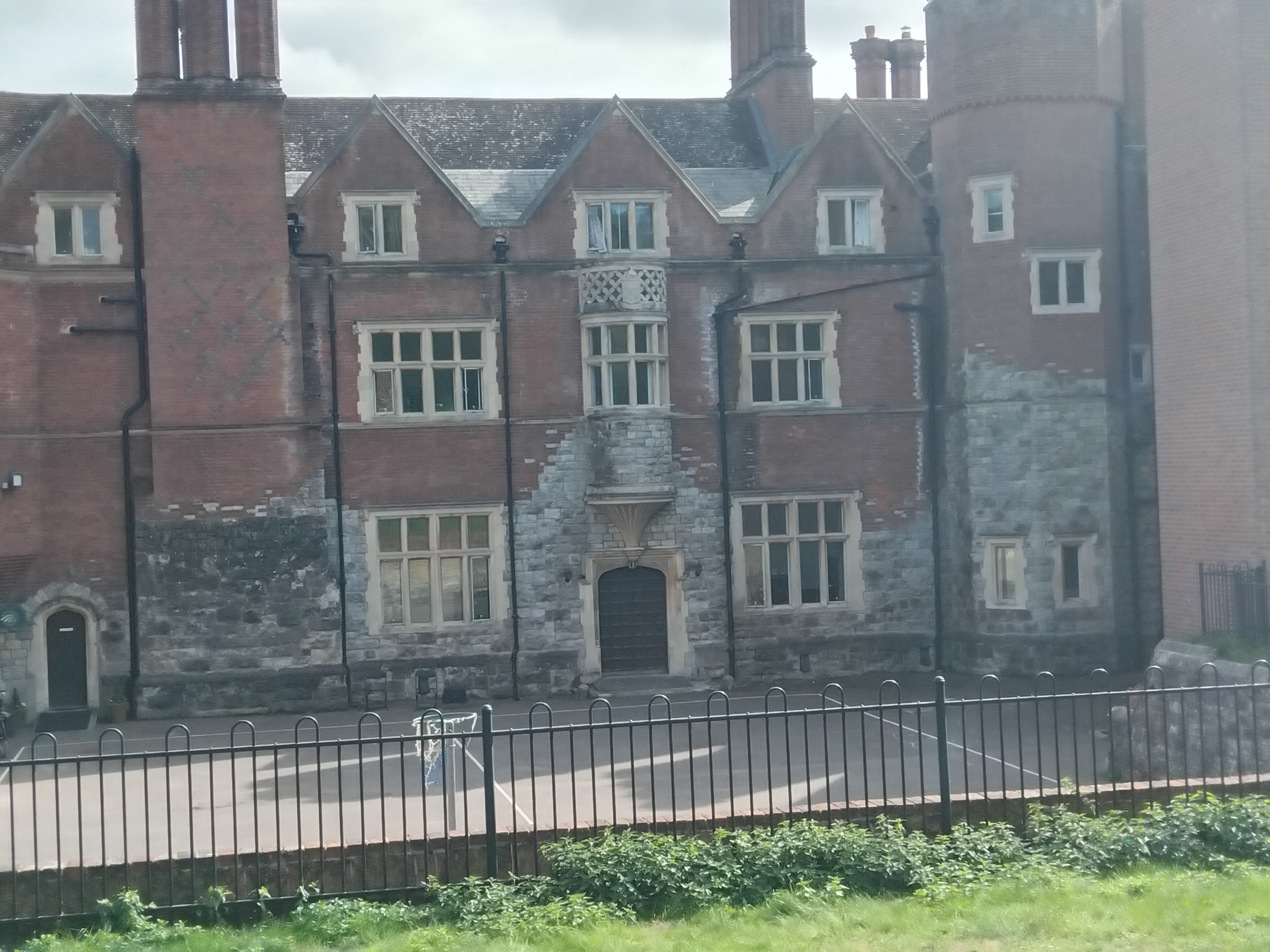
This place was an old country estate; some of the houses here were built around 1997, when the Bruderhof established themselves at Beech Grove, and other buildings date to the 1960s, including the one where religious services and communal events are held. Jack shows me the outside of the community high school, which is a listed building from the seventeenth century. The modern structures show reasonable taste, although some lighter colours to go along with the red brick would complement the setting. Nothing about the physical location suggests it is home to a group that is in many ways apart from the rest of society. And aside from noticing some people in traditional attire, a lost passerby would not find much to differentiate it from estates elsewhere.
Men mow lawns and chop wood. I am taken to the factory where goods are made. I see a farm and a garden providing food. It is customary for members to eat regularly together, and this feeds into a wonderful homely rhythm that contrasts favourably with the din, discord, chaos, and stress of cosmopolitan urban life where people ceaselessly scramble about to somewhere or other.
And how many people might like something similar to the Bruderhof life, where a community works for the betterment of their pre-political we? Monetary management aside, much of their lifestyle seems more attractive than a routine of employment by a company that means little or nothing to you. And how many might trade working within a random group of disparate types with whom they have no reason for association other than the dictates of a human resources department?
The reality of the group’s labour being inseparable from their cultural and spiritual identity must imbue their work with profound meaning. The shaving of every blade of grass, the sound of every piece of falling wood, and the experience of every vegetable growing ripe are in harmony with the Bruderhof ethos. Such an agreement between beliefs, affinities, and work is very hard to achieve for lots of people today. Most of us, either directly or indirectly, probably give our time, effort, and money to businesses that disagree with us in some way. The Bruderhof lifestyle stands in opposition to this.
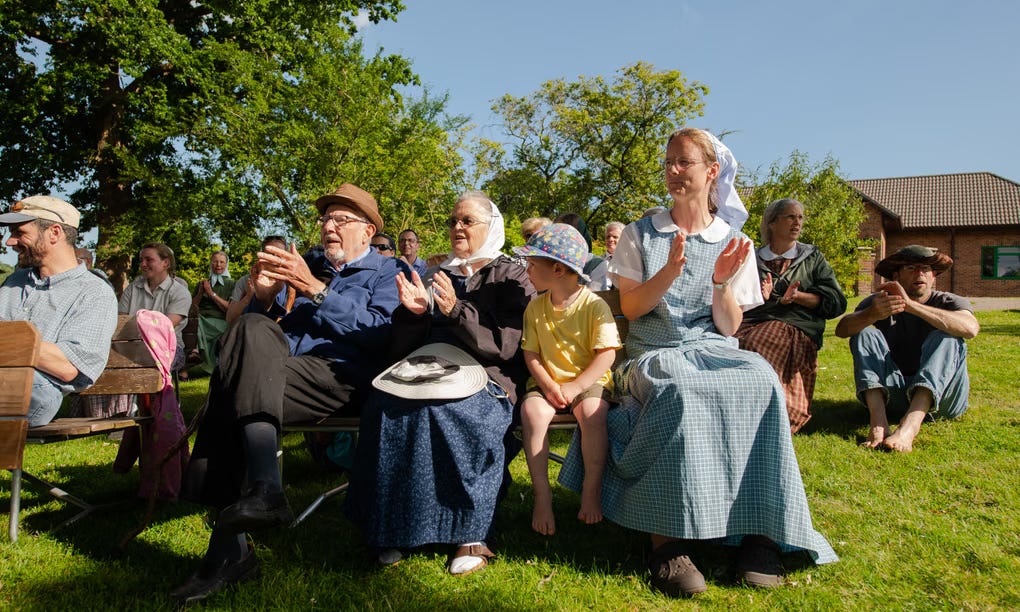
Jack and I enter a kitchen where communal meals are made. Women wearing roomy dresses and high-necked loose-fitting shirts are cooking lunch; some have head coverings, which are not compulsory here. Jack says some members choose to dress in a more traditional manner and others do not. My host explains that while there are no strict rules on what men wear, women must dress conservatively in public, although shorts are okay for physical exercise outdoors. Clothes worn by women making food are more traditional, whereas some men wear understated casual attire such as tracksuit bottoms and jeans. A man dons a Tottenham Hotspur hat, which is one among a fair number of indicators that the community does not wholly reject mainstream society.
When walking across the site, I detect elements of both the old world and modernity in the presentation of those I see. An older man who said hello to me on my arrival has a long beard typical of Amish men, and some of the women serenely pushing buggies dress in a traditional style similar to popular images of Amish life. But the appearances of the young men working on the lawns, chopping wood, and rowing a boat in the community lake do not suggest any separateness from mainstream society.
I raise the subject of the alternate modes of dress I have seen and ask Jack if there is a debate or point of dispute between members leaning more towards modern ways and reactionaries more tied to the past. Jack tells me that this dynamic exists, and as with other subjects, the community discusses these issues openly. He explains that there has been less emphasis on traditional clothing for men since the Bruderhof association with the North American Hutterite Brethren ended in 1995.
I remark that the small size of the settlement must make some form of consensus easier than in the country at large. He nods in agreement and states that cohesion in a society becomes more difficult, becomes impossible, when there are too many different world-views and cultural beliefs within it; I concur.
Cynics might claim the very facts of some members wearing branded and contemporary clothing and engaging with Netflix and other worldly things are signs of group decline. Although the community embodies an older and rural way of life, many of its early members moved to the first Bruderhof site in Sannerz, central Germany from cities. Their founder, Eberhard Arnold, sought a radical Christian life modelled on the early Church. From its beginnings, the community was reactionary. It seems reasonable to think that their origin story instils a watchfulness in members; this impression was conveyed when Jack was describing the way the group meets the technological challenges today.
The maintenance of their relative insularity is an impressive feat. I enquire about what measures the group has in place to uphold its identity and to stop more recent arrivals changing their community into something else. Again, Jack refers to a focus on discussing things together to arrive at consensus. He notes a lengthy publicly available document Foundations of Our Faith and Calling, which outlines the rules members must follow. For people accustomed to mainstream life, the transition is usually too much, and the group is not inundated with requests to join. The high barrier to entry, particularly the requirement to surrender all of one’s money, is conducive to an exceptional level of continuity.
The history of the Bruderhof is not one without upheaval. Their pacifist stance and other beliefs met the disapproval of the Nazis; they had to relocate, and the German Bruderhof were dissolved in 1937. Before leaving Germany, they established a branch in Liechtenstein before finding a Cotswold site in 1936. The restrictions Germans in Britain were subject to during the war led them to leave the country for Paraguay where they could continue their way of life (this was not quite an end of the Bruderhof in Britain, a predominantly British community did form in Shropshire and lasted for around twenty years). When their site in Paraguay closed and members dispersed to Europe and North America, its first American settlement was established at Woodcrest, New York in 1954. In 1971, the site at Darvell in Sussex, England was founded. Many members at Beech Grove descend from people who left Germany and ended up in America. I quickly intuit this by the American accents of many of the people I meet, including Jack; this indicates the extent of their separateness from the rest of the population.
The Bruderhof operates in the UK under a registered charitable company called Church Communities UK (Charity No.229226). Their religious character supports their charitable status, and community outreach initiatives, such as welcoming visitors, help them to meet the public benefit requirement demanded of charities in Britain.
I do not get the sense that the Bruderhof is a cult at all. I was told those who join do not have to abandon their family. And young members are encouraged to experience the outside world before taking religious vows at the age of twenty-one. Many go to university, some decide to leave the group, and others remain.
When I enquire about other visitors to the site, Jack tells me there has been a ‘‘revolving door” of late and that there is a balance between those who want to learn more about the religious aspect and others who have an interest in alternative modes of life more generally; he notes an increase in visitors with the latter concern in recent times. And there is definitely a lot to learn from the longevity of the Bruderhof that could aid those wishing to build communities.
For more information refer to the website for Beech Grove here, and read Bruderhof history here.
Likes, shares, comments, and restacks are appreciated.
If you enjoy my work and would like to give me some support, you can buy me a coffee here.
References
Bruderhof, ‘Heritage’, Bruderhof, https://www.bruderhof.com/foundations/heritage, accessed 27 September 2026.
Bruderhof, ‘Beech Grove’, Bruderhof, https://www.bruderhof.com/beech-grove, accessed 27 September 2026.
‘The Fate of a Christian Experiment’, The Spectator, 11 June 1937, p. 11, https://archive.spectator.co.uk/article/11th-june-1937/11/the-fate-of-a-christian-experiment, accessed 27 September 2026
Charity Commission for England and Wales, ‘Bruderhof Communities’, Register of Charities, https://register-of-charities.charitycommission.gov.uk/en/charity-search/-/charity-details/229226/governance, accessed 27 September 2026.
Premier Christianity, ‘Meet the Bruderhof: Our Exclusive Peek Inside a Modern Christian Utopia’, Premier Christianity, https://www.premierchristianity.com/features/meet-the-bruderhof-our-exclusive-peek-inside-a-modern-christian-utopia/606.article, accessed 27 September 2026.